Privacy and Discretion in AI Porn Chat: What to Verify
A privacy claim is only as useful as the specifics behind it, so the way to test one is to look for the settings and the pages that support it. The operator describes a private and secure environment and state-of-the-art encryption, which is a statement about handling rather than an absolute. Verifying it takes three checks: what the service says its content is, what it publishes about removal and complaints, and how your own account is set up.

Key takeaways
- Quote the claim as written — a private and secure environment with state-of-the-art encryption — and treat anything stronger as your own inference.
- The 2257 page is the load-bearing document: it states the content is AI-generated text and depicts no real person, updated in February 2025.
- Removal and complaint routes are published, which is what makes discretion verifiable rather than a matter of trust.
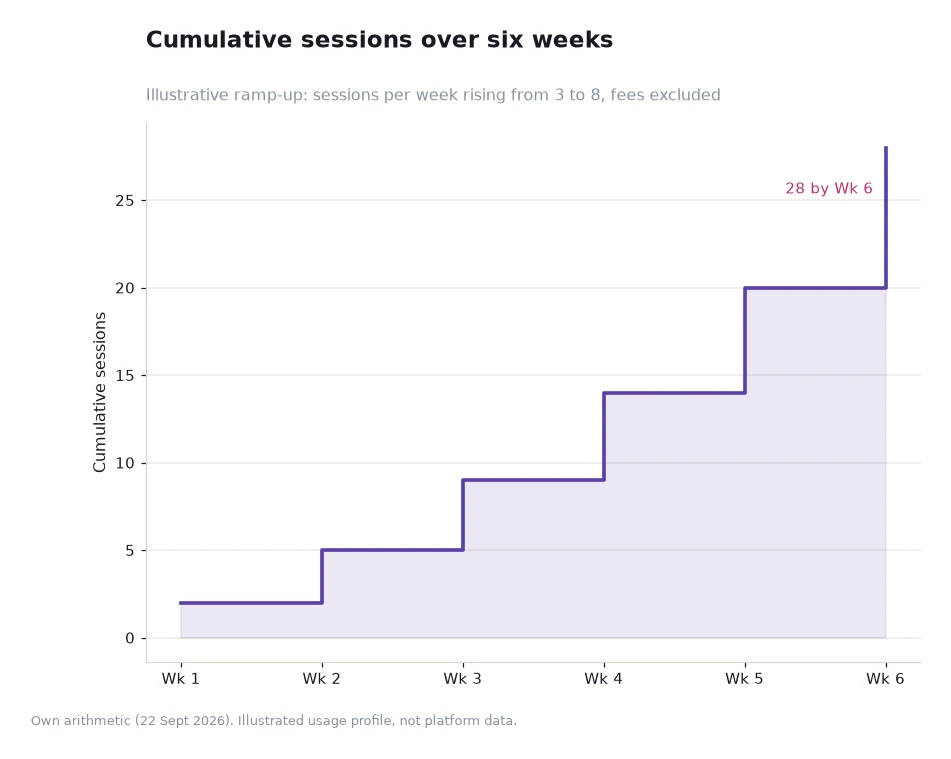
- An illustrated ramp of two sessions in week one rising to eight by week six reaches 28 cumulative sessions, which is enough to test a small set of cards without a heavy footprint.
Separate the claim from the absolute
Read the sentence and stop where it stops. A private and secure environment describes the design of the service; state-of-the-art encryption describes how traffic and stored data are protected. Neither phrase says that nothing is ever retained, and a service that wanted to say that would say it. Turning one wording into an absolute is the most common way readers misjudge what they were promised.
The practical test is whether the platform publishes documents that a claim like that would need. It does: a 2257 compliance statement, a content removal policy and a complaints policy, each linked from the site and each written for a general reader rather than for a regulator.
What the compliance page settles
The compliance statement carries the fact that determines everything else about discretion: the content is AI-generated text and does not depict real people. That single sentence removes a whole category of concern, because there is no person whose likeness or consent is at stake and no image or video produced by the site.
It also sets expectations for what a conversation is. A written character is a text artefact, and treating it as such is not a limitation on the experience — it is the experience. On Crushon, the interesting variables are how much context a card holds, how its style adapts over a thread, and how well a creator wrote the opening description, all of which are properties of text.
Test the claim against your own setup
Three account choices do more for discretion than any platform feature: a login address you control, a unique password, and a decision about which device carries the session. None of them is exotic, and all of them are in your hands rather than the operator's.
Then decide how you use the account. Sessions that start and end in one place are easier to keep tidy than a running browser tab on a shared machine, and the habit costs nothing to adopt. This is where the porn ai category differs from a social feed: there is no discovery-by-location and no suggestion to publish anything, so the footprint is almost entirely a function of your own habits.
| Check | The question it answers | Where the answer lives | What it cannot tell you |
|---|---|---|---|
| Content status | Is any real person depicted? | The 2257 compliance statement | Anything about your account |
| Handling wording | What is claimed about privacy? | The platform's own product copy | Retention periods in detail |
| Removal route | How is a problem reported? | The content removal and complaints policies | How quickly a case closes |
| Account hygiene | Who else could reach the session? | Your own device and password choices | Nothing — this part is entirely yours |
Worked example: a light footprint, quantified
The chart alongside this section tracks cumulative sessions over six illustrative weeks: two sessions in week one, then three, four, five, six and eight. Adding them gives 2 + 3 + 4 + 5 + 6 + 8 = 28 sessions, and the cumulative line reads 2, 5, 9, 14, 20, 28 at the end of each week.
Now convert that into time. At 20 minutes a session, 28 sessions across six weeks comes to 560 minutes, or a little over nine hours spread over about six weeks — roughly 93 minutes a week. The session counts and the session length are both stated assumptions about an illustrated usage profile rather than platform data.
The point of the arithmetic is that discretion and heavy use are not the same axis. A reader can keep a genuinely small footprint and still have enough sessions to compare half a dozen cards properly, provided the sessions are deliberate rather than reflexive.
What to verify before you commit attention
Verification is mostly a matter of reading three pages in the right order. Start with the statement that defines the content, then the content removal policy, then the complaints policy; between them they answer what the service is, what happens when something goes wrong, and who to contact. Each is linked from the site, and each takes under two minutes to read.
Then set the account up to match. Pick a login address you can recover, keep the password unique, and decide in advance whether you sign out at the end of a session on shared hardware. Those choices are the difference between a claim you have to take on faith and a claim you have squared with your own habits.
A Porn Chat AI service can be judged on the same three questions you would ask of any writing platform: does a thread hold together over a long exchange, are the rules published, and can a problem be reported without hunting for a contact. Answer those three and what remains are ordinary decisions about routine and time.
A useful habit is to re-run these three checks once a year. Policies get revised, statement dates move, and a page that answered a question last spring may answer it in different words now.
Frequently asked questions
Does the platform say the content is real?
No. Its compliance statement says the content is AI-generated text and does not depict real people, which is why no images or video of people are offered anywhere on the site.
Is the privacy wording an anonymity promise?
It is not written that way. The wording describes a private and secure environment with state-of-the-art encryption, which is a statement about how the service handles data.
What can I check without creating an account?
The published policies, the compliance statement and the catalogue's filter structure are all visible before sign-up, so most of the verification work can be done first.
How many sessions does it take to judge a card fairly?
Two or three conversations is usually enough. Under the illustrated ramp above, that fits inside the first two weeks with sessions to spare.
Verify, then relax
Read the claim, read the documents that support it, then set the account up so that the rest is habit rather than vigilance. Discretion on an adult AI chat service is a short list of decisions made once and revisited occasionally, not a permanent state of attention. Handle the list and the sessions can be what they were meant to be: unhurried text conversations with characters someone wrote.
Data and sources: the 2257 compliance statement[1], content removal and complaints policies, and the platform's product wording, all read 22 Sept 2026. The six-week session ramp and session length are illustrated assumptions, not platform data. Material for adults 18+.