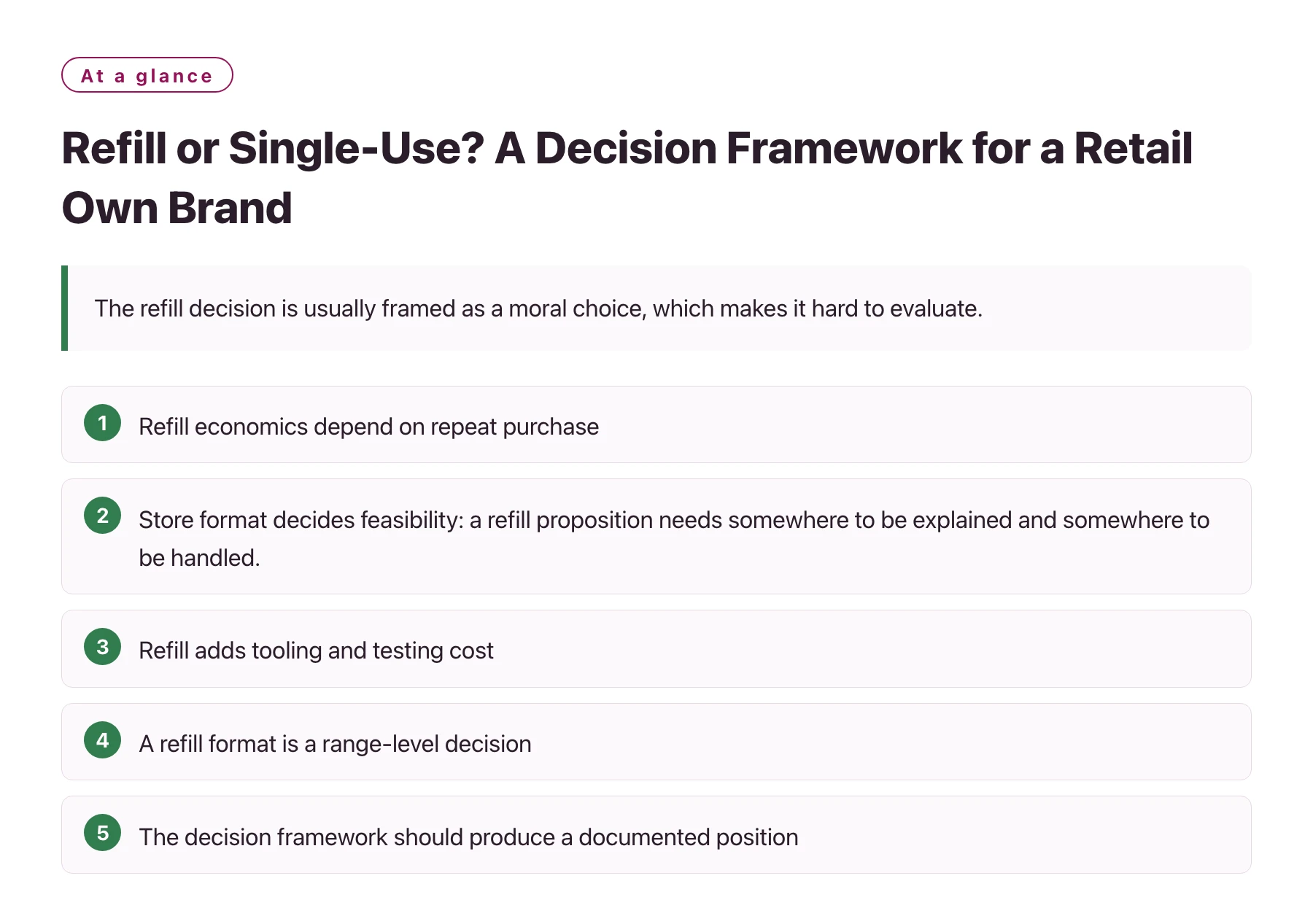
The refill decision is usually framed as a moral choice, which makes it hard to evaluate. Framed as a commercial one, it becomes answerable. Refillable and sustainable packaging pays back when the shopper returns, when the store can support the format and when the pack survives repeated use; it costs more when any of those three is uncertain. A retail own brand should decide which of its ranges is a candidate before it asks a supplier for prices, because the same question costs very different amounts depending on where it is asked.
Key takeaways
- Refill economics depend on repeat purchase, so the first question is whether the scent is one a shopper will buy again.
- Store format decides feasibility: a refill proposition needs somewhere to be explained and somewhere to be handled.
- Refill adds tooling and testing cost, which is only repaid across repeat sales of the same pack.
- A refill format is a range-level decision, not a SKU-level one, because the pack is usually shared.
- The decision framework should produce a documented position, so the next range can reuse the reasoning rather than repeat the debate.
Most refill debates inside a retail business start with the environment and end with the price, which is the wrong order. Starting with shopper behaviour and store operation makes the price question much smaller, because it removes the ranges where refill cannot work.
This framework is written for the person who owns the own-brand fragrance programme and has to recommend a position rather than a product.
The real question is which ranges, not whether
A retailer does not decide to be refillable. It decides that one range, in one part of the store, will be built around a refillable pack, and that the rest will not. That narrower decision is easier to test, easier to reverse and much easier to cost.
The reason to narrow it is that refill economics are driven by repetition. A refill programme recovers its extra tooling and testing cost through repeat purchases of the same pack, so a scent bought once a year by a small number of shoppers is a poor candidate, while a well-known scent bought every few months is a good one. Material and chemical choices interact with that logic as well, because a pack that is difficult to recover or reuse carries its own footprint cost [1].
It also helps to separate the pack decision from the claim. Publishing refill capability on the site, as www.xuelei.com does for its manufacturing services, is a supplier statement about capability, not a shopper proposition. The retailer still has to decide whether the proposition makes sense at its own shelf.
A five-step decision path
- Step 1: test repeat purchaseLook at the closest comparable range. If the average shopper buys once, refill is a design statement rather than a commercial model, and the case has to rest on brand positioning.
- Step 2: test the storeDecide where the refill is sold, how it is explained and who handles a returned or leaking unit. If no colleague can describe the mechanic in one sentence, the format is not ready for that store.
- Step 3: test the packConfirm that the container, closure and refill unit can survive repeated use at a cost the price point can carry. This is the step where suppliers with container capability, such as a custom fragrance development partner, save the most time.
- Step 4: test the claimWork out what the pack will be able to say, and what evidence supports it. Reuse and reduction claims need a documented basis, and the direction of packaging policy is toward more substantiation rather than less [2].
- Step 5: test the rangeDecide whether one hero scent, a shared pack across several scents, or the full range becomes refillable. For private label perfume production in China programmes, a shared pack across the range is usually the cheapest way to test the concept.
Signals that point one way or the other
| Signal | Points toward refill | Points toward single-use | Why it matters |
|---|---|---|---|
| Repeat purchase rate | Regular repurchase of the same scent | Gifting or one-off trial purchase | Refill cost is recovered across repeat sales |
| Store format | Counter with staff and space to explain | Self-select shelf with no service | Refill needs a moment of explanation |
| Range width | A small, stable core range | A wide, seasonal or rotating range | Shared packs only pay off on stable ranges |
| Price point | A price that can absorb a heavier first pack | Tight entry price points | The refillable primary pack usually costs more than a standard bottle |
| Pack type | A container that can be refilled cleanly and repeatedly | A pack chosen mainly for print or shape | Refill performance is a mechanical property |
| Shopper education | A brand that already explains its products | A brand that competes purely on price | The format has to be understood to be bought |
Count the signals rather than weighing a single one. A range that scores on repeat purchase, store format and pack type is a genuine candidate even if the price point is tight.
Where the refill case is stronger than it looks
Two arguments are usually underestimated in internal debates, and one is usually overestimated.
Underestimated: the pack becomes part of the brand
A refillable container stays with the shopper for months or years, which is a longer brand exposure than any carton provides. That has a merchandising value which never appears in a unit-cost comparison, and it is the reason some retailers accept a thinner margin on the primary pack and recover it on refills.
It also changes how the product is presented. Experiential retail for scent, the kind of thing an a museum built around smell explores, works because scent is remembered through the object and the moment rather than the words. A pack that the shopper keeps and refills is a small, continuous version of the same idea.
Underestimated, tooling is where the money sits. Injection tooling, closure fit, seal validation and repeated-use testing are one-time costs that must be divided by expected refill sales. If the range is withdrawn after a season, that investment is not recovered, which is an argument for testing the concept on the smallest viable pack.
Overestimated: the shopper demand signal
Stated preference for refillable packaging is consistently higher than observed purchase behaviour, particularly when the refill carries a price premium or requires an extra trip. Treat stated interest as permission to test, not as evidence of volume. The honest version of the business case is a small pilot with a measured repeat rate, and a decision point afterwards.
Write the decision down as a position with a review date: which range, which pack, what repeat rate would confirm it, and what would end it. A written position stops the same debate from being rerun every season with the same information.
Sources
- UNEP: Chemicals and Pollution Action —— The UN Environment Programme's pages on chemicals management, including the sound management of chemicals in products.
- European Commission: Packaging Waste and the PPWR —— EU rules on packaging and packaging waste, including the Packaging and Packaging Waste Regulation requirements on recyclability and design.
Frequently asked questions
Is refillable packaging always the more sustainable choice?
Not automatically. The advantage depends on how many times the primary pack is reused, how the refill is transported and what material the refill unit uses. A refillable pack used once or twice can carry a higher footprint than a lighter single-use pack, which is why the claim needs a documented basis.
Which ranges are the best candidates for a refill format?
Ranges with regular repurchase, a stable core of scents, a counter or service point where staff can explain the mechanic, and a price point with room for a heavier primary pack. Gifting ranges and fast-rotating seasonal ranges are usually poor candidates.
Does a refill programme require a different supplier from a standard line?
The supplier needs container development as well as fragrance and filling capability, because fit, seal and repeated-use performance are the hard part. Where those capabilities sit in separate companies, the retailer ends up owning the interfaces between them.
How should a retailer test a refill concept before committing?
Start with one hero scent in one pack, in a limited set of stores, and measure the refill repeat rate rather than the launch sell-in. A pilot of that shape costs much less than a range-wide rollout and produces the number the business case actually needs.
What does the decision framework produce?
A written position: the range, the pack, the evidence behind the claim, the repeat rate that would justify expansion, and the condition that would end the programme. It also produces a reusable template, so the next range can be assessed in an afternoon instead of a quarter.